A goal that never quite went away
When I was a kid, I heard the story of a messenger who ran a marathon distance, delivered his message, and died afterward. For some reason, I knew I wanted to do that.
The running. Not the dying.
That story planted an idea that stayed with me. Years later, while working on my master's degree, I tried training. Eventually, I gave up. The marathon went back into the category of things I might do someday.
Deciding to actually do it
At the beginning of 2025, I had started trying to lose weight, but I was slipping back into old habits. I had even started hiding what I was eating in my truck.
Near the end of April, I met my girlfriend for an appointment. Being her usual bubbly self, she hurried over to open the passenger door and greet me—and found the snacks.
She didn't say anything. I could just tell she was disappointed.
The next day, I decided that if I was going to do this, I needed to actually do it. I downloaded a food-tracking app, paid for it, and started learning how to understand my nutrition.
But the deeper goal was to learn how to do difficult things without giving up.
I've always been good at learning new things quickly. Something that required steady work over a long period of time? That was where I tended to quit.
This time, I focused on learning to eat better and move more. Those were things I could practice every day, even when the scale didn't give me an exciting result.
Five seconds that changed the goal
I started walking more. I also tried a Couch to 5K program, but that attempt left me hurting badly enough that walking was difficult for a few weeks.
So I went back to walking and kept working on my food habits.
One day in November, my son was walking with me. He had been pestering me about running, and I had kept telling him I couldn't. That day, I told him I wanted to jog the last little stretch to the house.
He was shocked.
We ran together for maybe five or ten seconds. That was it. But the freedom I felt was incredible.
For the first time in a long time, running felt possible. I knew I could work with that.
A marathon? Really?
Yes, a marathon.
I agree: that was an ambitious next step after a few seconds of jogging.
The St. Jude Memphis Marathon was on my mind because I kept hearing about the upcoming event. And the old marathon goal was still there, almost laughing at me—telling me I wasn't good enough and never would be.
If I was learning to do hard things, this would be the next hard thing.
I couldn't find a training plan that matched my starting point and the time I wanted to give myself. So I built a long training progression using existing plans, a spreadsheet, ChatGPT, and a lot of adjustment along the way.
Progress—and the parts that were hard
As I write this, I'm approaching the end of that training progression. It has been rough, and I wouldn't present my exact approach as a plan someone else should copy.
For me, increasing running distance while continuing to lose weight has made both goals harder to manage. I've had to balance training, fueling, recovery, and staying healthy enough to keep going.
That tension is part of the story too. The progress has been real, but it hasn't been effortless or perfectly tidy.
Data through October 5, 2026.
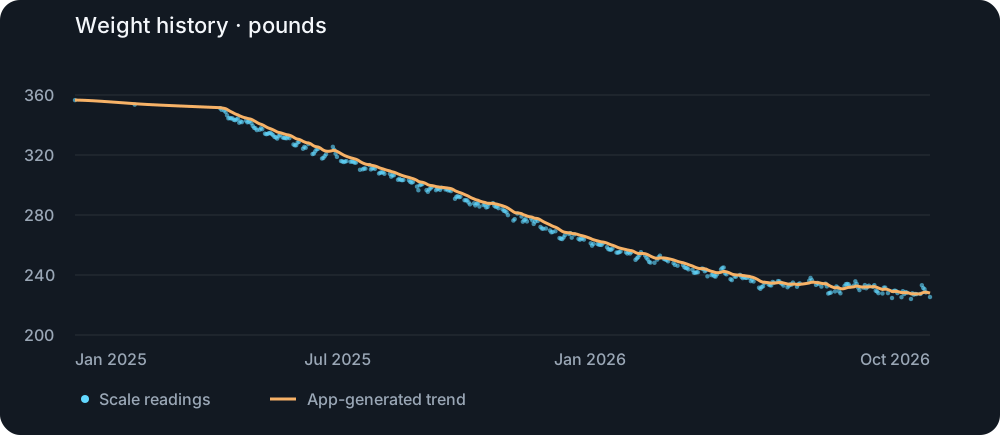
My recorded scale weight went from 356.6 pounds on January 13, 2025 to 225.32 pounds on October 5, 2026. That's more than 130 pounds.
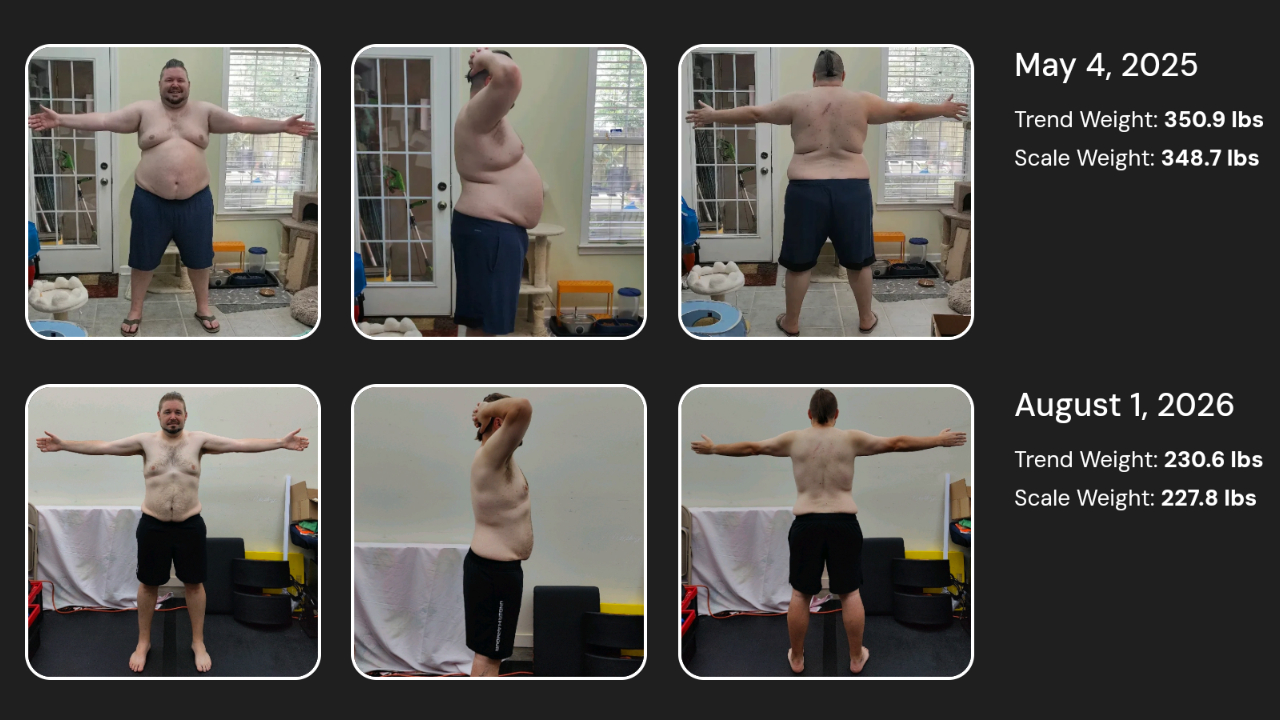
I still have moments when I look at that number and can't quite believe it. Seeing a two at the beginning of my weight still feels strange.
What comes after the finish line?
The rest of this year is focused on the marathon and recovery afterward. Then I want to return more attention to fat loss, work toward getting below 200 pounds, and see how I feel there.
If the race goes well and I still want to keep running, I'm already interested in longer distances next year.
It isn't just running that I enjoy. It's the freedom I've gained because of it—the ability to do things I used to assume were beyond me.
Supporting St. Jude
I'm preparing for the St. Jude Memphis Marathon through an event entry provided by my employer. While I haven't been actively campaigning for donations through my own page; my main goal here is to help raise awareness.
If you have a friend or family member participating, please consider supporting St. Jude through their fundraising page. Help them reach the goal they're working toward.
If you'd like another option, my St. Jude fundraising page is here.
You can also tell someone about the race weekend, come out to encourage the runners, or find another way to support the event.
For me, this started as a challenge I wasn't sure I could meet. Sharing the journey is one way to make it about more than just my own finish line.